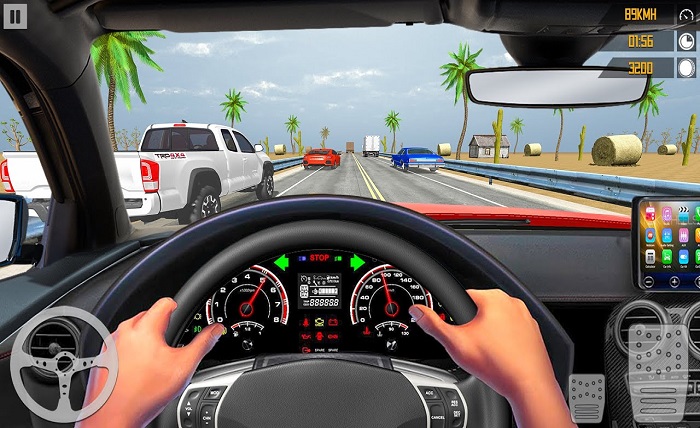
Driving games are no longer confined to screens and controllers. Augmented reality (AR) and virtual reality (VR) are reshaping the genre, turning racing and simulation titles into immersive experiences that blur the line between digital entertainment and real-world interaction.
From Screens to Simulations: How Driving Games Evolved
When such old titans of the racing genre as Pole Position or Road Rash graced arcades, they deployed pixel graphics and crude gameplay. The immersion was actually there, and the thrill was genuine, the limitations were in technology. Game engines transitioned towards a PC and smartphone, played with higher quality graphics, more realistic physics and playable network challenges. Nonetheless, the interface between players was flat, even though it improved.
VR and AR have started defining the new boundaries. Players no longer have to marvel at the track but rather be on the driver seat virtually. Using VR glasses like Meta Quest or Playstation VR2, the gamers are immersed in a 360 degree surrounding where their turns, glarity, and the noise seem real. AR takes this one step closer by overlaying the game elements on top of the real-life landscape-you can race video games on your local streets with a headset.
This jump is not only about the appearance of driving games but also their feeling. The sense of speed, danger and payoff is elevated making experiences with the device even more realistic than the use of official controllers.
Immersion, Emotion, and Realism in Gameplay
AR and VR in driving games are most likely to be effective because of immersion. VR headsets also include tracking head motion so the gamer can flick a glance into the rear-view mirror, look into blind spots, or lean into corners as though they are actually in a car. Alerting haptic feedback on steering wheels and feet, helps add touch dimensions so that even virtual paralysis is meaningful.
Emotions are compounded as well Research indicates that VR elicits more powerful physiological measures- blood pumps faster, palms get clammy and adrenaline gets amplified as it does when humans drive. Such feels form part of what feels the players glued to the game. HAR works its magic due to the combination of real-life roads and incitement of the game. Getting to work might be styled like a time trial, or car parking might be incorporated in some skill challenge.
These technologies make the game interactive through using sight, sound and touch to break the boundary between the game and the player. For those eager to explore extended discussions of immersive gaming psychology, simply read more in behavioral research archives where scientists examine how humans react to virtual environments.
Opportunities for India’s Gaming Landscape
The gaming industry in India is among the fastest-growing industries in the world and as per the recent statistics it stands at a value of over $3 billion in 2023 and still witnessing an upward trend. Driving games have also been extremely popular because vehicles, roads, and traveling to work and back are part of the culture. With the emergence of AR and VR in the region, new opportunities have emerged to the developers and game players.
Digital payments via UPI, wide coverage by smartphones and 4G connections have greatly democratized the availability of games. The developers in India are trying localized driving games, rick-shaw challenges, street anarchy games or nature sceneries such as the Western Ghats. These themes can be extended through VR and AR, and share Indian realities directly connected to them.
Cultural festivals and malls are already seeing VR arcades, giving first-time users a taste of immersive play. Meanwhile, esports tournaments focused on racing games hint at the potential for competitive growth. If infrastructure keeps pace, India may soon become one of the leading markets for immersive driving experiences.
Challenges and the Road Ahead
Although the potential still exists, there are some pitfalls to the development of AR and VR in driving games. The VR devices are still very costly to the ordinary user and this category is unable to capture the market in countries like India. Motion sickness is also a barrier as there are some users who have difficulties on handling long sessions.
Software developers will also have to circumvent hardware constraints Smooth gameplay is necessary to have high frame rates and accurate motion tracking that might not exactly be present on any device. AR has its own stiff challenges such as precisely overlapping the graphical figures with the rapidly moving real world background.
Innovation is pursued nevertheless. Wireless headsets are growing more affordable and companies are also investing in localization of experiences to reach a broader audience. It also can result in a less expensive hardware cost since VR-quality graphics can be streamed to a simpler device.
The path forward is not smooth but the direction is clear. Immersive driving games are still in the embryonic or experimental stage but as cost comes down and it becomes more of a technology, it will become normalized, as smartphones have done in India as a consumer medium.
Conclusion
AR and VR are transforming the genre of driving games. Saying that what began with pixelated cars on plain screens progressed into simulation where people get the sense on a rush of actual speed, pressure of split-second choices and the pleasure of manipulation immersion.
By integrating technology and psychology, the same platforms intensify feelings, reality, and the involvement of the players. India is a fertile ground to grow as it has a young tots and a high digital infrastructure. There are still a few hurdles such as cost, accessibility and comfort, but history has shown that over time hurdles tend to be overcome due to innovation.
Driving games in AR and VR symbolize more than entertainment; they showcase the future of how humans will interact with digital worlds. With every new headset or update, the line between reality and simulation grows thinner.